


The Problems with “Christianity”
April 6, 2010Most of you probably already know I’m a Christian, but I know there is a growing number of people that may wonder why anyone would want to be a Christian. There is a definite distinction between Biblical Christianity and the generic “Christianity” that dominates society. This causes so many to turn to agnosticism or atheism. Too many take a blind leap of faith into any category, whether it’s a modern day denomination, agnosticism, or atheism.
Doesn’t God and Christianity cause confusion?
There are some today who argue that the world would be better without God, Christianity, or religion. The reasoning behind this thought process generally results from the confusion and hypocrisy they observe in so many denominational churches that exist today. While that reasoning seems good, it’s severely flawed. Examining a derivative or a denomination is not examining the standard, that is, the Bible.God is not the author of confusion (1 Corinthians 14:26-33). However, some claim that because He confused the languages at the tower of Babel (Genesis 11:1-4), that He is the author of confusion. By doing so, they fail to understand that the context of 1 Corinthians 14 refers to confusion concerning speaking order, and more general, the order of the assembly. Also, those building the tower of Babel were apparently already confused about God’s initial command to “fill the earth” (Genesis 9:1), by trying to “make a name for [their]selves, lest [they] be scattered abroad over the face of the whole earth,” (Genesis 11:4). (See Apologetics Press for more details.)
Mankind is indeed the author of all doctrinal confusion today. It seems the reasons are as numerous as the denominations existing today. Taking things out of context is the biggest problem. Men authored the contradicting creed books and commentaries that exist today, not God.
Some contend that men wrote the Bible, but God wrote through men (2 Timothy 3:16). With the Bible’s scientific foreknowledge, historical accuracy, and available manuscripts, there’s no good reason to doubt it’s divine origin. A great deal more could be said about the Bible’s authenticity, but not within the scope of this article.
People Pick and Choose
Many people want to believe what they like and remain willfully ignorant of what they don’t like regardless of its source or credibility. It’s preferable to look at the shiny side of a dirty coin. The children of Israel rejected knowledge many times from the Old Testament to the New (Hosea 4:6).While people like to believe in things like faith only, purgatory, and miracles today, among many other things, they have no Biblical basis. People like to ignore the Biblical truth concerning marriage, divorce, remarriage, homosexuality, alcohol, and many other things explicitly discussed in the Bible. One group says one thing while another group says another, everyone teaching what they believe without consulting the Bible. As a result, people conclude, “wouldn’t we be better without God,” without knowing the Bible in its fullness, if at all.
Unfortunately, there are some genuine Christians out there who are unfaithful, causing reproach on the church. (1 Peter 1:13-16, 1 Peter 2:11-12) If you’re someone outside of Christ’s church, you can’t properly judge the church using an erroneous sample or too small of a sample.
What about Bible contradictions?
The Bible has many critics. In most situations, people want to disregard it because they don’t like the idea of being held accountable for their actions in this life or they do not desire to live a proper righteous life. Nevertheless, the Bible has stood the test of time, and you can find answers to most of the alleged contradictions and discrepancies at Apologetics Press - Alleged Discrepancies.There’s a big difference in simply reading the Bible and understanding the Bible. This is not to say that the Bible is difficult to understand. In many cases, people are usually given “help” to misunderstand it. Unfortunately, there is much of that “help” out in the world today.
I like to take an objective view of everything, including the Bible. There are too many people that make decisions based on something they “feel in their heart.” Although I understand that few would agree with the Bible, I’d have more respect for an agnostic or a “Christian” (with a blind faith not based on the Bible) seeking the truth, than an atheist.
Why I prefer Cinema 4D over Maya
April 3, 2010If you plan to develop something in 3D, maybe you’ve wondered what software package would be the best for you, (unless you plan to develop your own and reinvent the wheel). Some of you may already know that I have a preference for Cinema 4D, but I would like to discuss why. That doesn’t mean I necessarily mandate Cinema 4D to be “better” than Maya, it really depends on your needs or preference.
Which is more efficient at rendering?
In the 2008 fall semester at Collin College, I decided to try an experiment. I rendered a turntable of my final character project and a flythrough of my environment project. (See the projects in my 3D Modeling and Rendering II gallery.)I used both Maya 2008 (Mental Ray) and Cinema 4D 10 with a near identical scene setup for the turntable. I tried a few different settings for the turntable in each software package, but the results were virtually similar.
For the flythrough in Cinema 4D, I included my character lying on the bed since I hadn’t imported it into Maya. Notice that I also used a slower computer for the flythrough render in Cinema 4D. This wasn’t intentional, I simply didn’t have the opportunity to use the school’s faster computer.
Each computer had 3GB of memory. The render resolution was 720x486.
| Animation | Animation Length | Computer Speed | Software | Render Time |
| Turntable | 8 seconds | 8 cores @ 2.0GHz | Maya | 1 hour |
| Turntable | 8 seconds | 8 cores @ 2.0GHz | Cinema 4D | 7 minutes |
| Flythrough | 16 seconds | 8 cores @ 2.0GHz | Maya | 1.5 hours |
| Flythrough | 16 seconds | 2 cores @ 2.4GHz | Cinema 4D | 20 minutes |
Please note that I didn’t use anything special like global illumination in these renders. Also, Cinema 4D has actually doubled its own render time in version 11.5, whether using things like global illumination or not. Unfortunately I still only have version 10 as of this writing.
I was first introduced to Maya in spring 2006 at Collin College. Render time was one of the first things I wondered about. Why did it take so long to render something on a computer that’s faster than mine? I thought it may have been the network or background tasks, but running Cinema 4D from my USB drive still outperformed Maya. If you think something was completely amiss concerning this test, please tell me what was wrong and/or suggest some settings I should use.
What about workflow?
Workflow is really a matter of preference. I’ve heard people say Cinema 4D is good for learning, but I have to ask, why stop there? I think I can understand why it would be easier to lean Cinema 4D. It has an intuitive and well organized interface which is also highly customizable.Maya’s interface seems slightly more cryptic but basic tasks are still easily understood. Unless you understand what the terms mean, you could get lost. If you’re used to it, there’s no problem.
In another note, I think Blender 3D would dominate if it had a customizable interface so people that like to be flexible with other software could actually use it along with the others. I know there’s a few people that tout Blender’s interface, but it’s worthy to note that not everyone works the same way. What’s efficient to one person may not be efficient to another who has equally tried several methods.
What about the bugs?
On a few occasions I have had Cinema 4D crash on me. It gives me a notification and usually saves a copy of my open file in an error report folder. As a result, I usually don’t loose any work. There are occasions where the saved error file is understandably corrupt, but I have never had any problems with other saved files being corrupt.Unfortunately, I have heard much worse things about Maya from classmates and instructors at Collin College and in UTD’s ATEC department. Instructors always seem to warn about Maya crashing and corrupting files. I also hear of complaints about bugs with new releases of Maya and instructors suggest using a version below the latest.
The only other problem I’ve seen with Cinema 4D is crashing while using OpenGL on a computer it wasn’t installed on (i.e. running from my USB drive). Once I disable it however, there isn’t a problem.
What about scripting?
Scripting is probably what makes Maya attractive, especially because it uses Python. Scripting is essential when it comes to game development. Cinema 4D has scripting using COFFEE and Xpresso which aren’t really common at all. However, like Maya and many others, it also comes with an SDK that uses C/C++.Is Autodesk the standard?
Metaphorically scratching my head, I couldn’t help but wonder why Maya is considered an industry standard. Asking a fellow student in my small business class, who does architectural work with AutoCAD, said because it’s Autodesk. He likewise voiced his grievances and frustration with buggy Autodesk software.I suppose I could liken Autodesk to Microsoft, but I have to give Microsoft credit. Microsoft realizes it has real competition in the corporate world whereas Autodesk doesn’t truly seem to notice. People use their products because companies use their products. However, even Adobe keeps a pretty high standard for their software quality.
Anthropomorphic Character Modesty (1 of 2)
March 27, 2010In our normal world, there is a general standard where humans wear clothing and animals don’t. In the world of art and animation however, we mix the two in the form of anthropomorphic characters, and this complicates things. When does it become necessary to draw the line with clothing and modesty? Let’s examine this prior to a survey I wish to conduct.
Does it matter?
It’s likely that most artists don’t closely consider or even care whether what they present is modest or immodest. But if you’re targeting a mass audience, it becomes necessary to address this issue. It’s also likely that most people don’t care, but you need to consider your specific audience. As a Christian according to the New Testament and as an artist, I must be particularly aware.Whether you’re a Christian artist/viewer or not, you likely have standards. But those standards are for humans, so anthropomorphic characters can be ambiguously sticky.
What are modesty and immodesty?
Before we can assess what’s “modest” and what’s “immodest” we need to know what they mean. Here are some definitions for modest:- the Free Online Dictionary, Thesaurus and Encyclopedia: Modest
- Dictionary.com: Modest
- An American Dictionary of the English Language (Volume 2; New York: S. Converse, 1828), by Noah Webster
- the Free Online Dictionary, Thesaurus and Encyclopedia: Immodest
- Dictionary.com: Immodest
- An American Dictionary of the English Language (Volume 1; New York: S. Converse, 1828), by Noah Webster
- “disinclination to call attention to oneself”
- “conventional proprieties”
- “free from showiness or ostentation”
- “having or showing regard for the decencies of behavior, speech, dress, etc.”
- “offending against sexual mores in conduct or appearance”
- “indecent”
- “shameless”
- “unchaste”
- “lewd”
- “obscene”
- “arrogant”
What makes an anthropomorphic character modest or immodest?
Animals don’t wear clothing and are generally modest. However, as an artist adds more human characteristics, we naturally perceive it more like a human. Therefore it becomes necessary to add clothing.And vice versa, when the character is more animal like, clothing may be unnecessary if no “sexy bits” are present. Clothing may even distract the viewer from the main point of the subject matter. An unclothed character more animal-like than human-like isn’t generally lewd assuming the subject matter isn’t lewd.
Unfortunately, what makes a character modest or immodest is not only dependent on an artist’s presentation, but a viewer’s perception. Therefore, it becomes necessary to know the average viewer’s perception. The keyword is “average,” there are always exceptions. Some won’t find anything particularly immodest while some will find practically everything immodest.
There’s always some out there who will perverse
If you’re an artist that’s concerned about what you present, don’t beat yourself up when things seem to go awry. Even if you actually left nothing to misinterpretation, some people can still find a way to pervert it. Your work will sometimes be criticized and taken out of context.Consider that even God’s work, the perfect Author and Artist, is sadly misrepresented all the time. Concerning modesty and clothing (for humans), these are Biblical standards I adhere to (see context for details):
- Exodus 20:26 - “Nor shall you go up by steps to My altar, that your nakedness may not be exposed on it.”
- Exodus 28:42 - “And you shall make for them linen trousers to cover their nakedness; they shall reach from the waist to the thighs.”
- Isaiah 47:1-3 - “Uncover the thigh, Pass through the rivers. Your nakedness shall be uncovered, Yes, your shame will be seen;”
- Nahum 3:5 - “I will lift your skirts over your face, I will show the nations your nakedness, And the kingdoms your shame.”
- Matthew 5:28 - “But I say to you that whoever looks at a woman to lust for her has already committed adultery with her in his heart.”
- 1 Corinthians 6:19 - “Or do you not know that your body is the temple of the Holy Spirit who is in you, whom you have from God, and you are not your own?”
- 1 Timothy 2:9 - “In like manner also, that the women adorn themselves in modest apparel, with propriety and moderation, not with braided hair or gold or pearls or costly clothing,”
Adding batteries to your devices
March 24, 2010Whether you’re on vacation taking pictures and video or working on your laptop in the park, extended battery life can be a big help. Maybe you’ve lost or had a cell phone charger die and wondered if you could use an old one of the same voltage if it had the same connector. Adding more battery power or adapting connectors gives you a lot of flexibility. If you do it yourself, you may find it’s very inexpensive.
Develop a Common Connector System for Your Devices
Before you can add batteries to a device, you need to be able to connect them. I know “universal connectors” exist, but there are still plenty of devices that use special connectors. A simple solution is to splice into the cord and add RCA in-line connectors. I recommend using male plugs for the device connector and female jacks for the power source with a positive center and outer negative shield.In-line RCA female jack connectors aren’t as common as male plugs, but they’re still inexpensive compared to other connectors. Here’s a few places to get them:
- Alltronics: Audio Connectors
- Minute Man Electronics: Female In-Line RCA Jacks
- HomeTech Solutions: RCA Female In-Line Jack
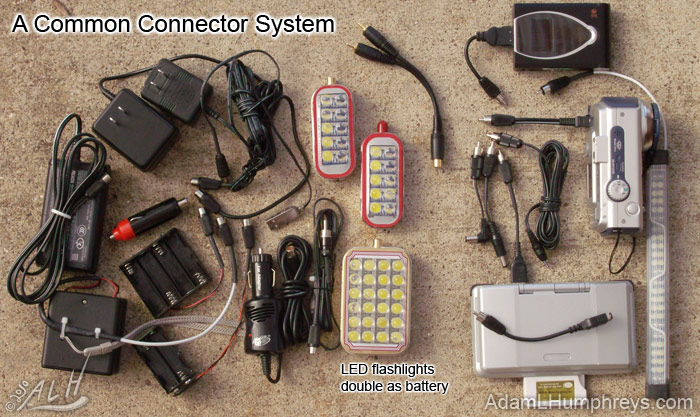
Where can I get battery holders?
- BatterySpace.com: Battery Holders/ Racks
- Radio Shack (locally or online)
- Newark.com: Battery Holders
- Amazon.com: Battery Holders
How many batteries do I need?
If you match the capacity, Ah or mAh (milliamp hours), of the existing batteries with that of the added batteries, then you’ll nearly double its operating time. But, you can have as many milliamp hours as you want wiring batteries in parallel. The important thing to remember is to match the voltage of the device’s power supply.If the device uses a transformer, use a multimeter to measure the actual device’s power supply output voltage when it’s connected to the device. A transformers’ output voltage is usually higher when disconnected while the specified output can be lower.
NiMH (and NiCd) battery cells (a single AAA, AA, C, D, etc.) are 1.2V per cell (nominal voltage). When charged, the cells are 1.4V. (Li-ion cells are 3.6V nominal and 4.2V charged.) If your device uses 5V, then you would need 4 NiMH batteries in series for 4.8V (5.6V charged). Most laptops use 19.2V from their power supply, so that would be 16 NiMH batteries in series.
What battery type should I use?
If you plan to extend the battery life of a device, a good choice is NiMH because of its availability and flexibility. Nearly every battery pack used in today’s devices use one of three types of chemistries:- NiCd (Nickel Cadmium)
- NiMH (Nickel Metal Hydride)
- Li-ion/Li-polymer/LiFe (Lithium Ion/Polymer/Iron Phosphate)
Make Your Own UPS
March 19, 2010Before uninterruptible power supplies (UPS) were made as a single unit, people had to make one with batteries, an inverter, and a charger. There are still advantages to doing this, like expandability and knowing how it will react to a situation. If you consider yourself an electronic hobbyist, you may find this is a fairly simple project.
Choosing Your UPS Type
The table below shows the basic differences between two major types of UPSs. The parts listed would be used for a UPS lasting about 15 minutes putting out 400W. If you can find them less expensive or want a different brand, go for it! If you want more power or a longer time, use a bigger battery, inverter, or charger accordingly.| Standby/Line interactive | Online | |
| What it does | maintains battery charge; it switches to the inverter powered by the battery during an outage | a charger powers the battery and inverter; it stops charging during an outage while the battery continues to power the inverter |
| Cost | less | more (the charger) |
| Complexity | more (the relay switch) | less |
| Power usage | less (small float charger) | more (charger and inverter; heat loss due to conversion inefficiencies) |
| Noise | less (fan on inverter during outage) | more (fans on the charger and inverter) |
| Parts list |
|
|
Putting it Together
Regardless of what UPS you’re building, you will inevitably wire the battery, the output of the charger, and the input of the inverter in parallel. That means all the black negative wires go together and all the red positive wires go together. You’ll need large wire to handle the current. Only the small float charger will use smaller wire.Setting up the Online UPS
Once you’ve wired everything in parallel, you’re done! Just plug in the charger into an outlet and plug in your equipment into the inverter outlet. If the battery is charged, unplug the charger and make sure it works.Building the Switch Box for the Standby UPS
The Schematic

If you’re not an electronic hobbyist, don’t let the diagram scare you too much, just follow it. The relay I suggested should have it’s own diagram on the top cover. The packaging of most relays indicate what pin number on the schematic corresponds to the pin number on the relay itself. Just match up their schematic with the schematic above. It should be very similar.
See “How it Works” below for an explanation of what “NC” and “NO” means.
For you electronic hobbyists, you know most relays use 12VDC. If you can’t find a relay that has a 125VAC coil like the one I listed, use a small 12V transformer and rectify the output to DC (or use an unused cell phone charger). Don’t use a capacitor! This would cause a delay in the relay switching time.
Putting it in the Box
Place everything in the box however you like, or at least in a way that isn’t obviously hazardous. If you have cords going out of drilled holes, make sure you smooth the edges of those holes. Tie knots into the cords inside the box so they can’t be pulled out. I used IEC connectors myself, check out my box (in the lower right hand corner).Connections to the relay should be soldered. Also make sure those connections can’t sort against the box if it’s metal. If it is loose in the box, cover it with electrical tape.
If you’re real cheap, you could just run cords (plugs and an extension cord end) directly to and from the relay and tape it up. … Not that I would recommend that. I like things to look neat.
Setting up the Standby UPS
- Make sure you’ve already wired the battery, charger, and inverter in parallel.
- Plug in your switch box line input into a wall outlet or power strip. The relay should click.
- Plug in your switch box inverter input into the inverter.
- Plug in your equipment into the power output of your switch box.
- Test it by unplugging your switch box from the wall, or switch off the power strip.
How it Works
The switch box works by using a relay to switch AC line power to inverter power when the line is off (outage). When line power is on, the relay is on. The relay closes it’s contacts that are normally open (NO), causing the line power to pass through to the socket and the equipment plugged into it.When the relay is off (loses it’s power from the line), the normally closed (NC) contacts are closed, and now power from the inverter powers your equipment.
Since this isn’t a “real” UPS, it doesn’t synchronize it’s output frequency with that of the line. If you plan to use it with a computer and monitor, which usually rectify their input to DC anyway, it shouldn’t really matter too much. I’ve never had any problems.
Using a Store-bought UPS
You might be able to buy a good UPS, but my experience is limited in this area. I’ve only had a 400VA APC UPS. It worked great for a while and it always seemed to test the battery when you turned it on. But it would always switch to the battery and back to the line when I turned my printer on.A year or so later, the APC UPS decided to just turn my computer off when I turned my printer on, failing to do its job. It wasn’t the battery because I continue to use the same battery for my own standby UPS. At some point, it just turned my computer off at random. The “cure” was now worse than the “disease” and intolerable. (UPDATE: It turned out to be the cheap relay. Read my article When electronics think they’re smarter than you for details.)
This doesn’t mean you can’t buy a good UPS, I just don’t know where. I didn’t get another one because I already had a good battery (which is a large part of the price). All in all, it seemed like the APC UPS was trying to protect itself more than the equipment that was plugged into it–too many stupid “smart” circuits.
Let’s go camping with solar
March 17, 2010Let us consider a possible scenario. You want to go camping and want to use solar power to charge a 12V battery connected to a 120VAC inverter to power your stuff. Calculating battery size and solar panel power is important if you don’t want to be left without power. Amp hours (Ah) work much the same way as watt hours (Wh). Multiply battery voltage times the Ah rating and you get Wh (more or less), but there are also other things to consider.
Let’s setup a possible scenario
Let’s say you would like to take a primitive camping trip. You want to make sure you have enough power to occasionally run your laptop and charge batteries for your camera. You would like to run your laptop for 4 hours a day and charge 4 AA NiMH batteries a day. Let’s also assume you’ll be gone for 5 days.As we go through this scenario, keep in mind that this same deductive reasoning can be applied to many different scenarios. Maybe you want to power:
- something during an outage
- your RV’s appliances
- your laptop through a 14 hour flight using a few parallel sets of 16 NiMH batteries in series
- a remote pond water pump
- Battery-Web.com - Frequently Asked Questions (FAQ) (see last question)
- Effects of Discharge Rate and Temperature on Battery Capacity and Life - Engineers Edge
- Sealed Lead Acid Battery Applications - Transwiki
- GB Industrial Battery - AH Ratings: 6hr rate vs 20hr rate
- Battery Performance Characteristics - How to specify and test a battery
How much power am I using?
To know how much power you need, you first need to know how much you’re using. If you can’t measure the current your laptop uses, check the power supply rating. Also, your NiMH batteries will need to have at least as many watt hours as they store. Don’t forget to compensate for conversion efficiency.Estimating Laptop Power Usage
Let’s say your laptop power supply puts out 19V at 4A – that’s 19V * 4A = 76W. However, it may only use that much power powering your laptop and charging its battery. If the battery is charged, assume 76 watts anyway. If your laptop actually used 60 watts, given a conversion efficiency of 85%, the actual power consumed would be (100% / 85%) * 60W = 70.6W. Running for 4 hours, that would be 76W * 4hrs = 304Wh.Estimating Battery Charger Power Usage
If you have 4 AA NiMH batteries with a capacity of 2500mAh (2.5Ah), then 1.2V x 2.5Ah x 4 = 12Wh needs to go into those batteries. Again assuming a conversion efficiency of 85% for the battery charger, let’s say we need (100% / 85%) * 12Wh = 14Wh.Total Usage
So, all together you’ll be using about 304 + 14 = ~320Wh a day. To err on the side of caution, let’s say 350Wh.Where will I get my power?
It’s unlikely that you’ll have a MPPT solar power converter that will work directly for your laptop or batteries. (Although you might be able to charge 10 AA NiMH batteries in series with a 12V charge controller.) So you’ll likely need a 12V SLA (sealed lead acid) battery and a 120VAC inverter. If you bring a big enough battery, you won’t even need a solar panel, but that would be quite a heavy battery.Estimating Battery Size
Assuming you’re using a 12V battery and your inverter has a conversion efficiency of 85%. To have enough power for one day the battery would need a capacity of (350Wh / 12V) * (100% / 85%) = 34Ah. For five days you would need 5 of these batteries or one 170Ah battery (34Ah * 5 day). But that’s about 140lbs of weight and it doesn’t take advantage of the sun, so let’s use only one with a solar panel.Estimating Solar Panel Needed
The battery we chose can store about 34Ah * 12V = 408Wh. Assuming a charge controller efficiency of 90%, we need about (100% / 90%) * 408Wh = ~450Wh from the sun. Let’s also assume the sun will shine adequately for about 6 hours (or a fourth of the day). You’d need a 450Wh / 6hrs = 75W solar panel, or an 80W panel which is more common.It’s not rocket science
March 14, 2010It’s true that the necessary parts to have a usable solar/wind system are fairly expensive, but the skill required to make it work isn’t rocket science. In fact, it’s probably easier than auto repair. Probably more often than not, contractors will simply follow the available instructions. At worst, they might cut corners. If you do it yourself, you could probably save quite a bit of money while knowing exactly what you did and how well it was done.
Do the Research and Planning
Chances are you’re reading this blog because you want to know how renewable energy works and how you can use it. If you don’t know how to do something, you research it and find out from those who do. I didn’t know a thing about Tesla coils until a couple of years ago. Since then I’ve made a few.Once you’ve developed a better understanding about how the parts work together and what they’re called, you can begin to plan. Here’s some good things to remember:
- Do your homework.
- Failure to plan is planning to fail.
- Plan your work and work your plan.
- Know your limits, (then reduce them).
- Make long term plans in short term intervals.
Consider Economic Efficiency
In some instances, it might be more economically efficient for someone else to do the work. What costs more? How much is your time worth? Let’s assume the following scenario as an example:- You normally get paid $15 an hour.
- You estimate it would take you ~20 hours to install your renewable energy system.
- That would cost 20 * $15 = $300 of your time.
- Unless someone else can do it for less than $300, you might want to do it yourself.
Consider Electrical Codes and “Qualified Personnel”
Perhaps you watched the Enphase Micro-inverter System Installation video I mentioned in my last article. Don’t let the phrases about electrical codes and “qualified personnel” scare you. Electrical codes are good to consider, but you can find and research this information on your own.What if I miss something?
Realize that people just like you already install their own light fixtures, ceiling fans, switches, and sockets. Be honest and ask yourself if you really think anyone has studied all the electrical codes. More than likely they simply follow the instructions. Realize also that even some of the jobs done by some “professionals” could be questionable if not disturbing.Common sense should always be used. Always turn the electricity off before servicing something electrical. By using common sense we also understand that like colored wires are usually connected together, you need larger wire for more current or power, and they shouldn’t be hanging out in the open. If there’s something you’re not sure about, ask someone or look it up.
What if I’m not “qualified personnel?”
What makes a person “qualified?” Do you think I’m qualified even though I’ve had no formal training? Does reading blogs, watching videos, and researching what you want to do, doing it, and then gaining experience make someone qualified? You must crawl before you can walk, but you won’t get anywhere if you don’t ever crawl.Notice the video says “all work should,” not “must,” but this is all according to who? The contractors, understandably, want to get paid. They’re licensed. The reason why they need a license is because they are in the business of installing systems for other people and therefore are liable. It’s unlikely that you will sue yourself if you screw up.
Some Personal Experience with Supposed Professionals
Preparing for a Hot Tub
At some point my dad decided we would get a hot tub. The people that delivered it would connect it, but we had to supply the wire and conduit they would use to connect it to the breaker box. (We also ran the required wiring from the main breaker box and installed the dedicated external breaker box. Understandably, they would only wire it to an available box.)Everything sounded good, but there was something fishy. They would not connect it to a GFI (ground fault interrupter) breaker in the breaker box because the hot tub already had an internal GFI circuit breaker. (Don’t we also want to protect the people outside the tub from electrocution?) When asked why, they said because a GFI breaker in a box would always trip without reason. But what they didn’t know, I researched on the web to learn about GFIs.
Learning about GFIs
A GFI is designed to detected differences in current in both the neutral and hot wires. If a GFI circuit breaker is far from the device it’s connected to, a delay in current causes the breaker to trip when it should not. However, our breaker box would be right next to the hot tub.Had the GFI been far away, at the main breaker box, then what they claimed would probably have been true. Needless to say, when the installers went through the trouble to bypass our GFI breaker, we connected it back like it should be and haven’t had any problems since.
Hearing From a Friend
One of my best friends used to work with a general contractor. He told me about some interesting things they did and did not do. Then there’s the issues with government and insurance contractors. If you plan to find a real good contractor, you may have to do as much research to find one as you would learning to do the work yourself.Using microinverters for solar power
March 13, 2010If you only plan to sell the electricity you produce back to the electric company and not go off the electrical utility grid, then the microinverter may be the most elegant solution. You use a single one of these inverters with every solar panel in the system. Simply connect the solar panel to the inverter and connect the inverter to your electrical box–only two sets of connections.
What are the benefits?
If you use a microinverter, expansion is easy. You can start with a single solar panel and inverter to have a complete grid tie system. Adding to it is almost like adding a set of Christmas lights to an existing set. The plugs and sockets are different because they’re made to withstand weather.In addition, microinverters give the advantage of maximum power point tracking (MPPT) for every individual panel. This means shadows or performance issues with one panel won’t affect the others. If you opt for Enphase’s microinverter, you also have the ability to get detailed day-to-day, hour-to-hour statistics for every panel! Watch the How It Works video for a video representation.
Where can I get one?
Microinverters are still somewhat new and haven’t really made it to mainstream as far as solar power is concerned. The Affordable Solar Group and EcoDirect have some pretty good prices, (but their solar panels are a bit pricey). There are many places on the web to get microinverters.The only microinverter that is currently available is from Enphase. Another is in development from SolarBridge.
How do I connect it?
Don’t be intimidated with wiring this device. If you can install a household socket or light switch, you can install this. If you can match colors and put up Christmas lights, you can install this. The instructions alone should make it very easy to understand.If you watch the Enphase Micro-inverter System Installation video, they make it sound simple, because it is simple. But, it does take some time. Don’t let the phrases about electrical code and “qualified personnel” scare you. I’ll discuss this in more detail in another article. Check out this New Jersey Solar Installation video for some good details.
Choosing a Solar Panel
All you really need to focus on is buying a compatible solar panel for the microinverter, (unless you’re comfortable with splicing and soldering the wires of an incompatible panel). You should be able to find a compatibility list in the support section of the company’s website. Enphase, for instance, has a download section.Connecting the Microinverter
First you generally need your inverter in place before you connect your solar panel. Run conduit up to your roof (or your panels’ location) to a junction box. Enphase prefers you to buy an AC branch “Install Kit” for $60, but you could easily get your own parts separately. Or, you could just run the inverter wires to a box and run conduit to an inside switch which would probably be cheaper, maybe $20. From there, just run wires into your electrical box to a circuit breaker. Check out Installing Electrical Conduit Systems for more details.Connecting a Solar Panel
The inverter and solar panel will likely have special connectors. These connectors are designed to be fool proof. But if you’re an electronic hobbyist you may want to get less expensive solar panels that aren’t on the compatibility list. If that’s the case, make sure you have the correct voltage, (you might need two panels in series or parallel). To connect a panel, just:- Cut off the connectors from the solar panel and inverter (this may void the warranty)
- Prepare heat shrink tubing to cover your connections by placing them over the wires (available locally at Radio Shack or online)
- Solder positive to positive, negative to negative
- Cover your connections with the heat shrink tubing and shrink it
Living on DC
March 8, 2010Most of our everyday appliances and electronic devices operate using AC (alternating current), right? … It might surprise you that most appliances we use today are using DC (direct current) rather than AC. Internally they convert the AC to DC. If you’re an electronic hobbyist, you probably already know that. If you’re using a solar system with batteries, you could save by using DC directly.
Reaping the Benefits
The benefits of running things off DC directly is that you have no conversion loss. Inverters and power supplies alike have a conversion efficiency. Most conversion efficiencies lie somewhere between 80-95%. If you can reduce the number of conversions, you will come out ahead. However, it may require you to have ten 12V batteries wired in series to obtain between 110-130 volts DC. You could use a DC-DC converter, but that would defeat the purpose.Distinguishing What Uses AC
First you need to know what you can and can’t operate with DC. You cannot use DC on anything that has a transformer on its power input. You can use these steps as a guideline to determine what can be operated using DC, but the only way to really know is to look inside:- If the appliance has a mechanical switch, turn it on unplugged.
- Use a multimeter to measure ohms (Ω) across the prongs of the plug.
- If the meter reads about 500 ohms or less, it likely uses a transformer.
- Air conditioning and heating systems
- General purpose fans and ceiling fans
- Washing machines/dryers
- Refrigerators/freezers
- Microwave ovens
- Garage door openers
- Fluorescent lights with ballast transformers
- Cell phone chargers (which are usually small wall mount transformers)
- Anything with an AC motor
Distinguishing What Uses DC
You can use DC on anything that has a bridge rectifier on its input. A bridge rectifier is something that converts AC to DC using four diodes. If you can measure around 1 meg ohm (MΩ) or more across the prongs of the plug using a multimeter, it most likely uses a bridge rectifier. Again, the only way to really know is to look inside. Most of the following items use a bridge rectifier or can use AC or DC:- Any lengthwise oriented or switching power supply (doesn’t mount on the wall)
- Computer/Laptop power supplies
- Incandescent, CLF, and LED light bulbs or Christmas lights
- DVD players and newer VCRs
- Game consoles
Replacing Wall Transformers
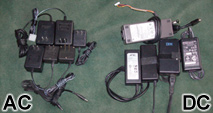
One of the most pesky things to deal with are those big black and inefficient wall transformers. The output of most of these are DC because they use a bridge rectifier on the output of the transformer. If you can find a switching power supply at the same DC output voltage to take it’s place, then replace it.Solar panel wiring
February 28, 2010Some may think there’s a lot to know about wiring a solar system, but the truth is the basics are pretty much the same as they were 20 years ago. Wiring solar panels is like wiring Christmas lights. There are several sites out there that show you the basics. However, it’s important to know when to use the methods discussed.
What’s your input device?
Before you buy solar panels, you need to know what you’re going to use to convert the solar power. Are you using a charge controller and/or a grid tie inverter? Here’s a couple of different things you could use (click on their description tab for details):- Kaco blue planet 1502xi Inverter
- PVPowered PVP1100-SD-120
- Morningstar TriStar TS-MPPT-45 Charge Controller
- OutBack FLEXmax 80 Charge Controller
Wiring
First, it’s important to know the basics. There are two basic ways to wire solar panels, series and parallel. Series arrangements increase the voltage of an array. Parallel arrangements increase the current of an array. Let’s use an 80 Watt, 12 Vpm, 6.6 Ipm solar panel for examples. (See my article about choosing solar panels to learn what Vpm and Ipm means.) Wiring panels in series:- +/plus/red to –/minus/black, +/red to –/black, + to –, etc.
- Three panels in series equals 36V at 6.6 Amps.
- +/plus/red to +/red to +, –/minus/black to –/black to –, etc.
- Three panels in parallel equals 12V at 19.8 Amps.
- Solar Energy Science Project Topics: What are PV Panels?
- Solar Energy, Power, Electricity
- Physical Computing at ITP | Notes / Solar Cells
- Learn how to wire solar panels and battery systems
- UPM Solar Decathlon 2009: Solar Roof
Series vs. Parallel
These wiring arrangements, though different, generally achieve the same result in terms of power. But there are differences you should consider:| Series | Parallel | |
| Electrical focus | voltage | current (amps) |
| Wire diameter | smaller | larger |
| Physical handling | easier | harder |
| Cost per foot | less | more |
| If one panel is in the shade: | the whole string produces less power | the other panels are unaffected |
The device you use to convert your panels’ power will determine your wiring arrangement, or vice versa.
Direct Solar-to-Grid Inverters
Most high power grid tie inverters (for solar systems) will require many series connections of solar panels. If you look at the input specifications for the first two devices listed at the top, they require 120-400 VDC.You’d need 25 * 12 Vpm solar panels in series to make 300V. Or, 5 * 60 Vpm panels. Notice how much current these inverters can handle, about 20A. They generally don’t need a lot of current at that high of a voltage.
Charge Controllers
Most high power charge controllers will require more parallel connections of solar panels. If you look at the input specifications of the last two devices listed at the top, they’re good for 45 or 80 Amps DC.You’d need 6 * 10 Ipm solar panels in parallel to make 60 Amps. Or, 2 * 30 Ipm panels. These charge controllers can still handle up to 150 Voc, but they’re designed to work with higher current. They generally don’t need higher voltage like solar-to-grid tie inverters. But keep in mind that the voltage should be higher than the voltage of your battery bank.
A close look at Inverloch
February 24, 2010I understand that a writer/artist has free reign to make a story any way they choose, especially if it’s for themselves. But as an outside reader, it’s no fun to vomit up something that tasted so good.
I suppose you could say my article has plot spoilers, but I think it’s more fitting to say my article is a plot warning. I suppose you could also say my view is “skewed” by my Christianity, but this is way beyond me: “At the end of the story, there is a main plot-twist that most fans of the comic hated” (WikiFur). The ending is hardly a plot twist as it is a plot train wreck.
My First Read of a Graphic Novel
Inverloch was my first time to read a graphic novel. To my dismay, it might be the worst. I’ve seen a lot of movies and played a few games. I admit that I haven’t read many regular novels, but I don’t think anything has completely let me down as much as Inverloch.I don’t doubt that some people liked or even loved the story. Maybe even you figured it out before the end and still enjoyed it. If so, you’re probably missing a big part of the picture concerning prejudice and racial segregation.
I like the style and layout. I like the few numbers of panels per page and the backgrounds. I love the characters (or I did). But being deceived from the very beginning and learning the truth at the end really breaks the scales. Learning the truth is a good thing, but it hurts to learn the basis of the story is built on a lie.
The Buildup
Official Description
Let’s read the description straight from the site (also see description on Kidjutsu):“The story of Inverloch centers around a young man named Acheron, from a horned wolf-like race called the da’kor. After a chance encounter with an elf, he finds himself setting out on a seemingly innocent mission - that of trying to locate Kayn’dar, another elf who has been missing for the past twelve years.
Meeting up with new friends and companions along the way, he quickly begins to learn that the world is not quite the peaceful place he believed it to be - embroiled with prejudice, racial segregation, and hidden danger. And the truth behind Kayn’dar’s disappearance is something none of the party would ever expect…”
Everything the novel seems to build up is essentially thrown out or never existed in the first place. Notice it mentions prejudice and racial segregation. This is built on early in the story.
Indicators of Prejudice and Racial Segregation
Here are a few excerpts (try to follow the context):- “We have something on an undeserved reputation…” (Ch. 1, p. 9, panel 3)
- “Oh! It’s just a cute forest animal.” later followed by “But da’kor… they’re horrid and vicious monsters.” (Ch. 1, p. 25, panel 1 (&3) and p. 26, panel 3)
- “You’re… not what I expected a da’kor to be like. I mean no offence, but everyone says how brutish and ill-tempered they are.” (Ch. 2, p. 8, panel 1&2)
- “Humans and elves hate us, fear us, despise us. All that does is breed the same feelings from the da’kor toward everyone else in return. …” (Ch. 2, p. 19, panel 1 (&3))
- “Shiara… I can’t change what I am…” (Ch. 2, p. 22, panel 3)
- “Naturally, the elves decided to blame the da’kor.” (Ch. 3, p. 8, panel 3)
What makes a person?
A far as I understand, a person’s personality makes them… them, their soul, their spirit. … You’re lead to believe Acheron is a da’kor (Ch. 1, p. 9). The reality is, the Acheron you’re introduced to is Kayn’dar, an elf in a da’kor’s body (Ch. 24, p. 11±1). The real Acheron at this time is actually a da’kor in an elf’s body, Kayn’dar’s body.Acheron’s Mother and the Other Da’kor
Did Acheron’s mother really know all along?
It’s strange that Acheron’s mother herself seems oblivious that “Acheron” is actually Kayn’dar, leading us into complete deception (Ch. 2, p. 3). She also says “You have such a kind heart, Acheron,” (Ch. 3, p. 12, panel 5), but supposedly she knows he’s not really his son. Is she trying to continue Kayn’dar’s deception?Acheron’s mother also says “There never was or will be any other da’kor like you,” (Ch. 3, p. 13, panel 2). Well, that’s certainly true of the body anyway, the only da’kor attribute, (and maybe some memories retained by the real Acheron). But the actual person isn’t a da’kor, it’s an elf who’s name is Kayn’dar.
Where did her hopes lie?
Consider that if Acheron’s mother did indeed praise “Acheron” knowing he was Kayn’dar, was her faith in the elves? It certainly seems like it (Ch. 24, p. 22, panel 4). I don’t think it could be said that she had any faith or hope in her own kind, the da’kor.Did she regard her real son?
We later see her “lament” her son’s brutal death: “He was always such a foolish boy…” (Ch. 24, p. 23, panel 1). The supposed irrevocable love between a mother and her child is severed. She simply dismisses her authentic son as a fool without pity. She was even presented with options (Ch. 3, p. 15), but didn’t seem to care. Even Varden sheds a few tears, for his father (Ch. 11, p. 30 & 31).So, the elves gain leverage through Kayn’dar who is rightfully praised as Acheron’s mother admits, “I was expecting to raise a rude and conceited child, but…” (Ch. 24, p. 23, panel 2-4). Unfortunately, this way by which the da’kor could change their minds about elves, is limited to Acheron’s mother and a select few da’kor. It’s interesting to note that these da’kor initially did this to save their own race (Ch. 24, p. 23 & 24).
Acheron’s mother seems to care about the da’kor as a whole (Ch. 24, p. 24), but it seems her son was just one of the numbers, nothing special.
Parenting
Why was Acheron foolish in the first place? … I’ll let the subtitle infer what you probably thought I had in mind. However, it doesn’t seem that Acheron’s childhood was really that bad (Ch. 2, p. 13). This brings into question whether the author actually knew which direction she wanted to go.Is there hope for the da’kor?
Maybe if the da’kor, even a few, changed themselves and stopped killing humans (Ch. 1, p. 12), they wouldn’t loose their numbers to humans (Ch. 24, p. 24). What better example could be set than one willing to risk life and limb to save one of another race, in public? Since “Acheron” traveled, his quest became known, his reputation was being built (Ch. 5, p. 24, Ch. 8, p. 19-22, Ch. 9, p. 20).What a lesson it would be for those of other races (along with the da’kor themselves) to learn what this “da’kor” did (or could have done) to save the elves, an act of selflessness. Acheron could have corrected a misdeed of his own people. But when it’s discovered that “Acheron” is an elf, (essentially reflecting an elven personality), imagine the mindset of all the elves who are prejudice, not Kayn’dar. I can almost hear some conclude, continuing the stereotypes against themselves:
- “Oh, Acheron was really an elf. It all makes sense now. No wonder he was so kind.”
- “Acheron was really an elf? The world needs to know he wasn’t really a dreadful da’kor.”
- “Does Kayn’dar really think there’s hope for the real da’kor? He never really was one of them.”
What about the author?
The one thing that really seems confounded is the real Acheron himself, living in a elven body, calling himself Silvah. He didn’t even seem to recognize his own body. This seems to be vaguely hinted (Ch. 18, p. 7-10, p. 24; Ch. 20, p. 19), but it also enables the author to take an undecided direction, even up to the end of chapter 23. But even given that, why would he trust Neirenn, who he knows to be against (or at least suspect) him, to shout “Behind you!” essentially causing him to destroy his own body (Ch. 23, p. 23 & 24)?Sarah Ellerton supposedly wrote the script before the drawing process. She said in an interview with Janet Houck, “The script hasn’t changed too much - the plot is basically the same…” But then she goes on to say, “The only major change I made since the first draft of the script was the ending, which was almost completely rewritten just before I started drawing.” (Inverloch’s Sarah Ellerton Tells All)
As far as I understand, usually the ending determines the conclusion of the whole plot. While most of the original script may be essentially the same, it’s meaning can change dramatically. It’s hard to rewrite the end without considering the whole. But then you’re left to wonder, what was the original ending? We may never know.
It’s interesting to note that her general inspiration seems to stem from Disney animation features. She also says, “I love simple, light-hearted fantasy stories more than brooding war-centered epics,” (Inverloch’s Sarah Ellerton Tells All). I don’t know about everyone else, but when I discovered “Acheron” wasn’t Acheron at all and his own mother lacked pity for the death of her own son, my heart fell into a pit (so-to-speak).
Driving a Wedge
The resolution reached doesn’t seem to stop or even slow the continuing prejudice and racial segregation against the da’kor or the elves. Unfortunately, it seems to compound it. In essence, the conclusion of the novel gives me no good reason to necessarily dispute the prejudice associated with the da’kor initially introduced. It’s so far from being resolved, it actually gives me a basis for it (back at ground zero).Acheron’s father’s generation didn’t seem to change (apart from Acheron’s mother and a few others). Acheron or his brother showed no change. Is there any example for the new generation? … I think I’ll steer clear of the da’kor knowing there’s none like Kayn’dar, the elf.
My Concluding Thoughts
I’d rather Acheron had been a martyr that was the catalyst to restoring “Kayn’dar’s” memory (as it seemed) than continue the reputation of his race as an untrusted people (as in Inverloch’s reality). … This would mean a change of Neirenn’s character as initially expected (Ch. 10, p. 28).But aye, it’s a cruel world now innit? Why else would the elf and human who embarked on Kayn’dar’s journey go steady to a life of crime (Ch. 25, p. 25)? Who’s to say Acheron’s mother isn’t really a human?
I will soon read Batman: The Dark Night Returns and Kingdom Come as part of my sci-fi & fantasy literature class. I doubt my experience will be at all bad compared to Inverloch. I know that I have also disappointed readers by discontinuing my own Set Apart series, but I didn’t destroy what I planned to build up. I admit my failure to plan properly.
Choosing a charge controller
February 21, 2010Solar panels and wind generators produce electricity, but their output varies widely based on the available sun or wind speed. Therefore there is a need to convert that output to something a little more consistent using a charge controller.
Do I need a charge controller?
Generally, you will not need a charge controller if you simply plan to sell power back to the electric utility company. You will need a charge controller if you plan to:- use batteries
- use an OutBack Power System (which requires batteries)
- use solar and wind power in the same system
- go off-grid, independent from utility power (usually a mobile or remote home)
- have a backup power source during outages (which requires batteries)
- power a portable inverter or otherwise large device (requiring a significant battery source)
What kind do I need?
There are almost as many different types of charge controllers out there as there are solar panels. However they all essentially do the same thing, which is charge batteries. The most common battery type used is sealed lead acid (SLA) or gel lead acid, which is very similar to SLA. Click here to see more.If you plan to use wind generators, the charge controller is usually built into the unit or comes with it separately. Therefore, you don’t need to worry about choosing a charge controller unless you plan to make your own wind generator.
What you need is largely based on what you plan to power and how often you plan to use it. In my article about choosing solar panels I discussed calculating power:
- V (Volts) * A (current in Amps) = Power (Watts)
How do I connect it?
Connecting a charge controller is fairly simple. There are usually two things to connect, sometimes three. You will always have to connect the solar panel(s) and the batteries. The labeling is fairly explicit. Consider these and look at the pictures:- SunGuard 4-12V charge controller
- Prostar 15, 12/24V Charge Controller
- OutBack FLEXmax 80 Charge Controller
Don’t be intimidated by the FLEXmax. It also has two simple connections, PV +/- and Bat +/-, it just requires larger wire. The FLEXmax is generally used in larger solar systems.
Wiring details should be outlined in the instruction manual for your specific charge controller. I’ll try to cover wiring in more depth at a later time.
Will incandescent lights die?
February 20, 2010There’s been a lot of advancement in the field of lighting, particularly solid state lighting with LEDs, but that doesn’t necessarily mean incandescent bulbs will phase out. Consider that they were probably conceived as a way to replace candles, and they excel at that, (heat and light). Also, candles haven’t phased out.
Today’s Applications
Incandescent lights still have a place in the modern world, but not necessarily as a lighting source. They produce light, but most of all, they produce heat. Here are some modern day applications:- Heat Lamps (more examples here and here)
- Reptile Heating and Lighting (more examples here and here)
- Incubation (more examples here and here)
- Easy Bake Oven
- Scentsy (a flameless scented candle)
- Plant Grow Lights
Give Me Heat!
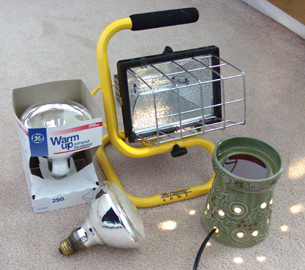 It’s been said that only 5% of the energy going into incandescent light bulbs results in light. 95% of that energy results in heat. I see no reason to refute this, they get hot! Now that’s efficient… for heat production.
Other places where people would prefer incandescent bulbs over the newer bulbs would be in cold locations or climates. If you move from Texas to a northern state, you’d probably prefer more heat. If you’re working outside on a cold winter day, those hot halogen work lights feel pretty good.
What about the Energy Independence and Security Act of 2007?
Some might be concerned about the federal bill that phases out incandescent light bulbs between 40 and 150 watts. (See Subtitle B, Sec. 321 in the full text.) However, there seems to be enough exceptions that a simple relabeling could probably circumvent such restrictions. Just because “incandescent light bulbs” may not be sold doesn’t mean “heat bulbs” can’t be sold.Then there’s the burning question of “who is the government to dictate what bulbs I can’t use?” I find it particularly disturbing that the government would do this (among many other things). But, I look forward to LEDs being used in lighting applications, because you get more light per watt of energy.
Reusing the CFL circuit base
February 18, 2010For you hobbyists out there wanting to reuse the parts from a burnt out CLF (compact florescent light), there are some ways to reuse the circuit in the base. With a few steps I’ll show you how to wire up a small florescent light to take it’s place.
Know what Failed
CLF lamps may fail because the filament in the bulb burns out, just like regular incandescent bulbs. If this is the case, the bulb doesn’t produce any light. If the CLF filaments at the base light up, but the rest of the bulb doesn’t, the electronics failed. This means you could use the base of another broken CFL to repair it.Open the Base
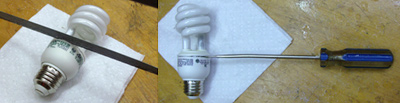 First you need to get it open. Some are fairly loose and you can easily use a flat tip screwdriver to pop it open. You might have to use a hacksaw on others and then use a screwdriver. Be careful not to break the bulb.
Get to the Circuit Board
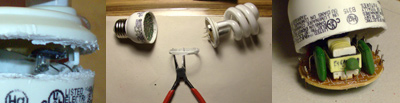 Once you have it open, just lift out the circuit board. Next, cut off the wires from the bulb at the circuit board. If you had to use a hacksaw, you may have to cut the wires from the bulb first and then pop out the plastic ring you sawed off.
Get a Bulb, Wire It Up
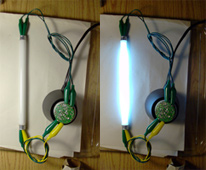 You saw two wires coming from each end of the bulb, right? Now, just get a small florescent light (like one found in a modern camping lantern) and connect it the same way as the other bulb was connected. At this point you probably realize that a compact florescent light is simply a florescent light.
Turn It On
Once you have everything connected, turn it on and see if it works! Assuming your bulb is good, there shouldn’t be a problem and it should turn right on. Be careful not to shock yourself!More Experimenting
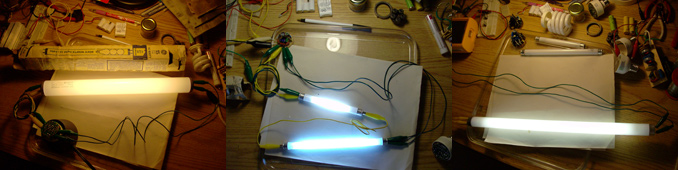 Try some different types of florescent bulbs and see what works best. Try some in series. Just keep in mind that the filaments at the ends shouldn’t be brighter than the rest of the bulb. They also shouldn’t flicker. If you observe this, you may be using excessive power to light the filaments than the whole bulb requires! Try a smaller bulb.
Is it on, off, or idling and how to tell
February 17, 2010I’m sure most of you have heard or read that some appliances still use electricity when they’re “off.” There is no doubt this is true, but how can you tell? Identifying what’s idling and what isn’t (without paying money for something like a Kill A Watt Monitor) is a good first step.
How much energy is really being wasted?
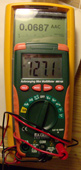 An idling appliance is something that uses electricity when it’s “off.” When “off,” they could use anywhere from about 5 to 25 watts. Usually these appliances have internal clocks or settings. Unplug the appliance if you don’t care to keep time or settings you may have saved.
A disconnected cell phone charger, laptop power supply, or any external power supply not connected doesn’t need to be plugged in. Depending on how they work, they could use anywhere from 0 to 10 or more watts.
Here are the results (in watts) of some measurements I took:
- Nokia cell phone charger (not connected):
0W - Laptop power supply (not connected):
2.5W - Ethernet router power supply (not connected):
8.9W - Cassette deck, “standby” (it’s not labeled “off”):
2.5W - VCR/DVD player, no clock, completely “off”:
5W - Older PlayStation 2 turned “off” from the front button:
6.3W - Older PlayStation 2 turned off from the back switch:
0W - Computer, completely “off”:
10W - Older VCR with clock, completely “off”:
13W - A Sony stereo system with disc changer, cassette deck, and clock, completely “off”:
25W
How can I tell if something is idling?
Common Indicators:
- Lights or a display is still on and working
- It hums or makes any noise when you put your ear right up to it
- It can automatically turn itself on (as through a timing function) if it’s “off”
- It is warm to the touch due to power dissipation
Typical Appliances that Idle when “Off”:
- Desktop computers made after 1995 (or after ATX was introduced)
- Laptops
- Computer monitors and TVs
- VCR/DVD/Blu-ray players
- PlayStation, Xbox, Nintendo, and other gaming systems
- Satellite receivers
- Cell phone chargers
- Answering machines
- Anything that has an external power supply
- Anything that keeps time
Push-Button Switches
Another way to tell if an appliance is idling is by the power button or switch. If the power button is small and requires a gentle push with a subtle “click” or “tap” sound, it likely idles.If the power button feels heavy duty, making a “click-cling” or a “click-clack” sound, it probably doesn’t idle. This is because these switches usually switch the wires straight from the power cord. It’s the equivalent to unplugging it. This is common in much older appliances, especially stereos and amplifiers.
Toggle Switches
If you have an appliance that has a toggle or flip switch like a power strip, it probably doesn’t idle. However, if the switch is small, thin, or light, it might use idle power.Too Much Hype?
Another point I want to get across is don’t be too optimistic. Most idling appliances use very little electricity. Also, new power supply designs continue to increase in efficiency during idle time. Consider that a laptop or cell phone also uses idle electricity when it’s completely “off” (unless you have no battery).Air conditioners and heaters make the meat of your electric bill, not idle power or lighting. Unplugging any one appliance will probably make a negligible difference. It’s when you have several that they have an impact.
Turning off a power strip to everything you’re not using is a good idea. Even the Smart Strip uses some idle power. If you’re still using any incandescent light bulbs, you’ve got a slightly bigger problem than idle power.
Choosing solar panels
February 16, 2010There’s a lot of different solar panels out there, and with so many choices, it would be helpful to know what to look for when buying one. I’m going to explain some of that technical jargon. This way you can better understand how or what panels to use with a given system.
Understanding the Spec./Data Sheet
Let’s say you want to check out a specifications sheet for a solar panel, like this one or this one. As you start looking at the tables, you’ll see terms like:- Polycrystalline silicon (or Multi-crystalline silicon)
- Monocrystalline silicon
- Open Circuit Voltage (Voc)
- Maximum Power Voltage (Vpm) (or Optimum Operating Voltage)
- Short Circuit Current (Isc)
- Maximum Power Current (Ipm) (or Optimum Operating Current)
(As we discuss these terms, keep in mind that voltage and current measurements are usually taken under a consistent test light source. The results should be comparable to good sunlight.)
Vpm and Ipm
These are the most important aspects of the solar panel because they determine power. Both Vpm and Ipm are the ideal maximums at which the solar panel functions. Looking at Ohm’s Law, we know that:- Vpm * Ipm = Power (Watts)
This may seem trivial and basic for some of you, but the point is that you need to know what is being advertized. What is a “12 volt” solar panel? Is it 12 Voc with about 9 Vpm? Or is it 12 Vpm with 18 Voc? I admit, it’s usually the latter, but you need to make sure.
MPPT - Maximum Power Point Tracking
Both Vpm and Ipm establish the maximum power point. When you see a charge controller or grid tie inverter, they may advertise a MPPT (maximum power point tracking) feature. All this means is it searches for Vpm and Ipm to get the most power from your solar panel(s).Voc and Isc
Consider Voc and Isc as the opposite extremes of Vpm and Ipm. Generally, you don’t really need to worry about these. You won’t get any power output at these extremes.Open circuit voltage, or Voc is the voltage measured when the panel isn’t connected, hence “open circuit.” Short Circuit Current, or Isc is the current (amps) measured when the panel is completely shorted, positive to negative.
Poly-crystalline vs. Mono-crystalline Silicon
This makes up the composition of the silicon used in the solar cells of a panel. Silicon is the same material that make up computer chips. You don’t really need to worry about the raw materials that make up a solar panel. But for your interest, here are some key differences:| Composition | Cost | Efficiency | Appearance |
| Poly-crystalline | less | less | usually rectangular or square without rounded corners |
| Mono-crystalline | slightly more | slightly more | usually square with rounded corners |
Buying a simple grid-tie solar system
February 12, 2010If you’ve done any amount of home improvement, then setting up a simple solar system isn’t a challenge. However, it would be good to know a few basics and what parts you need.
Please keep in mind you may have to contact your power company to learn specific code requirements. Where I live, our house wasn’t required to be wired to code; therefore I simply discuss what will work from a technical standpoint.
Jump in Head First
If you want to jump right in and buy a simple low cost package that outlines all the details, here they are:- ASG Power Plus 0.2 kW GT Kit
- ASGP+ Enphase Grid Tied Starter Kit - 175 Watts
- Hi iQ Telecom Ltd (eBay store)
How These Systems Work
These systems are very simple. Think of it as battery charger working in reverse, except the battery is the solar panel. A solar panel is connected to the inverter, which is connected to your breaker box. The inverter is “charging” your house using the solar panel “battery.”If you’re familiar with inverters used in cars for laptops, they are very similar. However, there is a serious difference between a grid tie inverter, and a basic inverter. A grid tie inverter synchronizes with the frequency (60Hz) and phase of the voltage from the power company. (Think of it as two people flipping a switch at the same time, in the same direction.)
Buying Parts Separately
The essential parts you need for a simple grid tie system is a solar panel and an inverter. You need to consider both items at once for a complete working system.Inverter
The inverter is what converts the input VDC (voltage, direct current) from the solar panel to the output VAC (voltage, alternating current) to your home. You need to consider voltage, both input and output. This will determine the voltage of your solar panel and how to connect it in your breaker box.Good inverters can work with a range of voltage input, like 10-30 volts DC or 40-60 volts DC. Output voltage is usually ~120VAC, ~240VAC, or ~208VAC. You need not worry about the last one, it’s for commercial three phase power systems. Check out my article Is solar power really affordable? for additional information.
Power Source
Solar panels come in lots of flavors and output voltages vary widely. (See my article about choosing solar panels for details.) Here’s a list with some common voltages according to open circuit voltage (Voc) and optimum operating voltage (Vmp):- ~18Voc (12Vmp)
- ~36Voc (28Vmp)
- ~58Voc (47Vmp)
- 12V
- 24V
- 48V
Hardware
As for mounting hardware, you could use angle iron or angle aluminum usually available at a local hardware store, Lowe’s, or Home Depot. Wood or angle brackets are other options, but I recommend against duct tape.If you go with a wind generator, tower kits are usually sold separately. You may also have to buy galvanized steel pipe for a guy-wire tower kit. See some examples here.
Putting Everything Together
After you’ve got the parts, all there is left to do is wire it and mount it. With such a simple system, all you have to do is connect the solar panel to the inverter. Afterward, you connect the inverter to your breaker box or just plug it in a standard household outlet. I’ll discuss wiring details in another article.Bible Articles?
January 13, 2010Many people may be confused why Bible lessons exists on my site which primarily functions as a portfolio. I should be showing and demonstrating what I do and not what I believe or feel, right? Well, it certainly isn’t about how I feel (2 Kings 5:9-11, Jeremiah 17:9), and I believe it dominantly because of its credibility. However, it is important to note that it is indeed what I do. It takes priority. This is not to say that I wish to contend with anyone or force the truths which I affirm upon anyone.
I haven’t contributed very many articles because there is so much reliable information already out there that’s openly available if you know where to find it. Apologetics Press is a good place to start.
A Review of Disney’s Bolt
November 30, 2008I went to see Disney’s Bolt yesterday (Nov. 29, 2008), and I must say, it seems to be truly enlightening. I just had to write a review for it (plus it doubled as part of a college assignment). If you haven’t seen Disney’s Bolt, I encourage you to do so. As a warning, this article will be a total movie spoiler if you haven’t already seen it, and it doesn’t function as a complete summary.
There is nothing like the opposites of the optimistic idealist and pessimistic realist coming together. Bolt the dog, the optimistic idealist, had been raised and pampered to think he is a particularly special special dog with extraordinary powers that prevail against anything (see “The Chase”), while he is really a TV star. Mittens the cat, the pessimistic realist, had been raised in perhaps an average domestic setting, declawed, and later abandoned to fend for herself, though at the expense of others.1 Both have preconceived ideas of what is and should be. Bolt believes everything will work out for the best and come to light while Mittens believes nothing can possibly be as good as it seems or sounds and things only seem to become worse.
Mittens initially seems to put more emphasis on what she doesn’t have, her claws, and clearly has a great yearning for what she has lost. This seems to establish her pessimistic view. (I fully suspect her name isn’t coincidence either.) She even goes to the degree of deceiving others as having claws when she doesn’t, just as Bolt with his powers, but she is knowledgeable whereas he is ignorant. Bolt initially seems to put more emphasis on what he thinks he has, his powers, and that no harm can come to him. This seems to establish his optimistic view, though he is under delusion. However, this is not to say that Mittens isn’t under a delusion. Though she can see and observe what really is, she is confined to believe nothing can get better as mentioned earlier.
The synthesis of these characters is what seems to manifest a true ideal. I’m inclined to say there is a great need for optimistic realists that strive toward the ideal. I would think that optimistic idealists striving toward the ideal would get stuck in the mode of thinking there is a definitive for something where there is not, where the optimistic realists would perhaps better seek out and know what is definitive and stay loose on what is not. The only difference I can see between a pessimistic idealist and pessimistic realist is one thinks there’s an ideal while the other doesn’t, but both would think such a thing is unattainable.
But when does this synthesis take place for a realist to seek for the ideal and the idealist to know what is real? Looking the optimistic idealist and the pessimistic realist in particular, it seems both have to reach rock bottom and reach a revelation. Before the “Animal Rescue” scene, Bolt seems to reach his rock bottom when he realizes the cage of an animal control truck was opened for him by Rhino the hamster, as opposed to him bursting it open as he initially supposed. Seeing his black bolt symbol rub off is another shocker to him as he receives his reality check, he really is a TV star who never knew he was a TV star. In the “Animal Rescue” scene, we see Mittens in her rock bottom state in the cage of the shelter, as she seems to be contemplating her gloom and doom without reflecting on any good that has happened to her. She reaches her revelation when Bolt comes to save her. Before this point, Mittens seemed to have a purpose of bringing Bolt’s optimistic views to a crashing halt. Likewise, Bolt tried to maintain his highly unrealistic views of the world.
It seems that a bit more people seem to be pessimistic and focus on the bad things that have happened in their lifetime. Everyone seems to have their own sob stories to tell, but what about smile stories?
Toward the end of the movie, we see the need for the one in the optimistic moment to build up the other in a pessimistic moment.2 Bolt had to be built up by Rhino before he felt able to save Mittens. Mittens likewise had to be built up by Rhino before she would follow with Bolt going back to Penny. Context is also very important. Without proper context, messages can often be distorted and could be spread in such a distorted state. As Bolt comes to Penny, his “person,” Penny is acting on a set and embraces Bolt’s replacement. He is left with the impression that what Mittens has asserted to always be true, that love is temporary, really is true. However, Mittens is there to observe the whole context, to see that after Penny’s synthetic embrace, she expresses her desire for Bolt to return. Mittens relays this observation to Bolt, and an optimistic grasp on reality is established.
I throughly enjoyed this movie. (I observed a user comment found on IMDB titled “Bolt brings back true Disney.” I am inclined to believe so, but not based on the user’s expounding of the CGI quality.) Despite my expounding and dissecting of this movie, I must say, it seemed to have revived me as a child and is filled with social redeeming value. It seems to remind me of my favorite movie as a kid, Cats Don’t Dance, as the characters are truly something to embrace. The only thing I can’t understand is why Mittens is third on the cast list as opposed to second. (Okay, maybe I do know, but that doesn’t seem a good enough reason for me.) Nevertheless, it seems there is some revival in Disney, or Disney·PIXAR anyway, in looking through their recent CGI movies such as Incredibles, Cars, Ratatouille, and WALL·E. Memorable stories and characters seem to be coming back.
Footnotes:
1 - Mittens is first introduced with a concern for lack food. This reminds me of Matthew 6:25-34/Luke 12:22-34, illustrating that the Christian need not worry over such things.
2 - As a member of Christ’s church, is is important to build up one another properly according to 1 Corinthians 3:9-17, 1 Thessalonians 5:11, et al.
About Instruments
November 30, 2008For everything Christ’s church does in worship, it does only as authorized by God in the New Testament. Often the church is accused of not believing the Old Testament, however, “whatever things were written before were written for our learning, that we through the patience and comfort of the Scriptures might have hope,” Rom. 15:4, and “For if that first covenant had been faultless, then no place would have been sought for a second. … … … In that He says, ‘A new covenant,’ He has made the first obsolete. Now what is becoming obsolete and growing old is ready to vanish away,” Heb. 8:7-13. Certainly we believe the Old Testament, because without it, how would those of the first century be able to identify Jesus as the Christ?
What is commanded?
We make music as commanded in Eph. 5:15-21 and Col. 3:16-17 (cf. Jam. 5:13, Acts 16:25). Notice that is says “one another,” indicating everyone is to participate in the singing. It is for this reason we have no choir with certain select individuals. Of course there may be those physically unable to sing, nevertheless, they can still make melody in their heart. As for instruments, since this deviates from what God has specified, this is not practiced by the church. … Now, to answer why.Can we Justify Instruments?
Many people will turn to Psalms to justify the use of instruments, but this was a command to the Jews under the OT. People will also say the Bible “doesn’t say not to,” but O, the gray hair one could grow by reading a list of “Though shalt not,” and O the things one could justify. People often go to the OT to justify things such as tithing and instruments in the worship, but why not other OT commands such as sacrifice, burning incense, the feasts, and stoning those found working on the Sabbath? This is nothing new, however, as those who had been under the OT law of Moses, when the NT arrived, tried to apply circumcision to those in the NT (Acts 15), which would be an example of someone trying to add to God’s word. Later, Paul made a declaration to those trying to obey things in Moses’ law in Gal. 5:1-6.Look at Old Testament Examples
Looking at Cain and Abel before Moses as an example for our learning, we read in Heb. 11:4 (cf. Gen. 4:1-5) that “… Abel offered to God a more excellent sacrifice ….” Both made offerings, but only Abel’s was accepted. Why? Because Abel offered it by faith, and “… faith comes by hearing, and hearing by the word of God,” Rom. 10:14-17. From this we can infer there was a command by God to sacrifice. Well, one could sacrifice just about anything, including children which God had not commanded (Jer. 32:35, et al). Since Abel did so according to the faith which came through the hearing of God’s word, and his sacrifice was accepted, we can conclude that God specified “the firstborn of his flock and of their fat” as opposed to “the fruit of the ground.” So God likely didn’t say to not offer the fruit of the ground, but specified the firstborn of one’s flock and of their fat. Certainly Cain was wanting to serve God just as sincerely as Paul (Acts 26:9-11), but he deviated from God’s word. In king Saul’s situation, “…to obey is better than sacrifice…,” 1 Sam. 15:22.Another OT example of deviating from God’s word is from Nadab and Abihu in Lev. 10:1-3. What made the fire profane, or unauthorized? The fire needed to be holy and come from the altar according to Ex. 30:22-30 and Lev. 16:12-13, though God did not say it couldn’t come elsewhere, yet we see the result.
Look at the Greek
There is no small dissension among the use of instruments being used in the worship. Nevertheless, despite the examples written for our learning in the OT, people continue to try justifying instruments by saying the Greek word for psalm, psallo, means to sing with instruments, but it also can mean simply to sing. (Greek interlinear: Eph. 5, Col. 5, Jam. 5, Acts 16) However, what most people tend to overlook is how words change over time. Initially in the ancient Greek during the first century, when the NT was written, the word was used almost exclusively for vocal singing. (In the same way, the Greek word for wine can be either alcoholic or non-alcoholic, but of course people try to justify their drinking by the latter.) An example from today–two incompatible phrases through a short time span of 50- years:1950s: “I’m gay.”
2000s: “I’m gay.”
Besides this, the actual command found in Eph. 5:15-21 and Col. 3:16-17 is adontes, which is simply “to sing.” But from Eph. 5:15-21, without even looking at the Greek, it says “speaking” in songs. There is also no example of instruments in the early church. According to history, instruments were first introduced by men centuries later after the establishment of the church in Acts 2. If God had asked just for music, any music would likely be acceptable, but He specified singing. If God had asked the Patriarchs just for sacrifice, any sacrifice would likely be acceptable, but He obviously must’ve specified the firstborn of one’s flock.
…
How is it condemned?
Concerning instruments in the worship, the Bible does not directly condemn it nor does it make mention of then in the New Testament. However, there are many things the Bible does not condemn in word, but in principle. In like manner, the Bible does not directly condemn the concept of a select few people partaking of the cup of grape juice mixed with apple juice, meeting in a bar for fellowship, or even arson. What is the real problem though? Many people are not satisfied with what God has specified (concerning many things) and instead want to do what God has not commanded (Leviticus 10:1, Deuteronomy 18:15-22). Rather than deny themselves (Matthew 16:24, Mark 8:34, Luke 9:23) and follow the OT principles written for our learning, man would rather amend or remove (to something that is already perfect and cannot be improved) what they feel appropriate. If I think something is okay, how does this justify my thinking unless I compare it to Scripture, as it has been said “‘For My thoughts are not your thoughts, Nor are your ways My ways,’ says the LORD” (Isaiah 55:8-9).Who are we trying to please?
The question is, are we seeking to please God or ourselves, or are we singing to God or ourselves? If we were indeed seeking to please God, we would simply do as he has commanded without trying to manipulate around what has been specified. Truly actions speak louder than words, and if one seeks to amend what is already specified and perfect concerning any issue, are they not showing a dissatisfaction to that which is perfect? Indeed, throughout the Bible, man is often rejecting that which is perfect, even rejecting Christ, the chief cornerstone (Psalm 118:22, 1 Peter 2:4-8, et al.). … Along with this, there is a sharp contrast between the old and new testaments concerning instruments. Had the idea of instruments in the worship been of any virtue, surely those from the OT covenant (who were commanded in many numerous ways to use instruments in the OT in Psalms) could take over their instruments into the NT covenant. Are not instruments merely part of that which has passed away?Faith consists of many things as elaborated in the NT (and OT examples), but some people say it’s “faith only” wanting to throw out the fidelity aspect and also despite being directly told it’s not faith only (James 2:24, cf. Galatians 5:6). Yet when the Bible only specifies singing, never mentioning or implying an instrument of any kind in the worship and no example, instruments are okay and it’s not “singing only.” Clearly men are looking for their own way seeking the things that work in their favor which indeed result in the confusion of many. The Bible does not say “faith only” in the same way it doesn’t say “singing only,” so why is it not faith only, but it is singing only? Faith is elaborated to include many things (dissatisfying men who don’t want all those extra things) and singing is simply left at singing (dissatisfying men who do want all those extra things).
What if it was spelled out?
Now suppose if God did specify “singing only”. Would this stop men from trying to use an instrument? Certainly not. Man throughout history choose to directly disobey God. In 1 Samuel 15:1-5 Saul was commanded to “go and attack Amalek, and utterly destroy all that they have, and do not spare them.” Certainly this is easy enough to understand, “destroy all that they have,” nevertheless God elaborated further by saying “But kill both man and woman, infant and nursing child, ox and sheep, camel and donkey.” But what happened in verse 8 and 9? “But Saul and the people spared Agag and the best of the sheep, the oxen, the fatlings, the lambs, and all that was good, and were unwilling to utterly destroy them.” Despite an elaborated direct command from God, Saul, set up as king by God for Israel, still disobeyed God, and man likewise does it all around today. … I submit to you that if God had directly forbidden instruments in worship, man would still use them, though certainly not as many.How far would you go?
Now suppose if we take the side that most do and say instruments are okay. Would there be any problem with using a Solid State Tesla Coil (SSTC)? Why of course not, yet why do I have a funny feeling that there would be objections from the farthest parts of the globe-“That’s going too far!,” “That’s crazy!” But if instruments are permitted since they are not forbidden, who is man to say this one shouldn’t be used to glorify God? Does not lightning remind someone of the power of God, so how much more this particular instrument? No, the problem is people go too far starting with any instrument, simply going beyond what is written (cf. 1 Corinthians 4:6). … I submit to you that if God had elaborated a specific list of instruments to be used in NT worship to Him, man would want to take some out and put others in, possibly including an SSTC.In fact, as far as the imagination of man can go, it would not surprise me to actually see an SSTC used in the worship by some denomination somewhere within my lifetime. This would not surprise me because according to some information I found, “In a message delivered in St. Louis on April 22nd, [1969,] Methodist Bishop James Thomas of Des Moines, Iowa advocated the use of hamburgers and a soft drink for the Lord’s supper,” (Searching the Scriptures, Vol. X, July, 1969, No. 7, page 4).
The concept of an earthly headquarters could also be one of those things devised by men since it is not mentioned in the Bible, but why is it to be excluded? Because Christ has already been specified as the divine head. God did not elaborate on any headquarters run by men, but it isn’t directly condemned by the Bible and it is not mentioned at all. I have heard of the concept of someone people juggling in praise to God. Why not burn incense to God? What is the result of such manipulative reasoning and compromises? I would have to say one result is the “United Church of Christ,” who go as far as advocating homosexuality.
Consider the “law of exclusion”
If someone orders “a salad” from a restaurant menu, certainly any kind would be acceptable. Salads take very many forms. If someone orders a fish salad, then should they expect to see it along with chicken? Salad with chicken is very popular, nevertheless, why would someone have to specify fish only? The law of exclusion necessitates fish only. But what of this so-called “law of exclusion?” Someone makes the argument “the Bible does not tell me to put on clothes when I go to church. God must therefore want us to worship in the nude,” (despite Matthew 6:25-34/Luke 12:22-34). It also doesn’t mention microphones or PA systems. In the same way, the Bible doesn’t say to worship with air, but then no form of music could exist. So when does this “law of exclusion” take effect? It takes effect when something in a category has already been mentioned. Thus specifying “music” for praise would exclude juggling, dancing, etc., etc. … An interior designer specifying “lights” could include neon, florescent, incandescent, and LEDs. Specifying “lights of florescences and diodes” would exclude neon and incandescent. Specifying “lights of incandescents” would exclude other lighting types. Several methods exist for powering all these lighting types, some with more special needs than others, but if they do not change the lighting type, it doesn’t matter because a method for powering has not been mentioned.Let’s say a conductor has told certain individuals to sing and other individuals to play specified instruments. If one of his singers, who was not told singing only, got out a cymbal and clashed at high notes, would the conductor not be confused? Are they justified in this? Likewise if someone on a bass guitar started singing, would this not confuse the conductor?